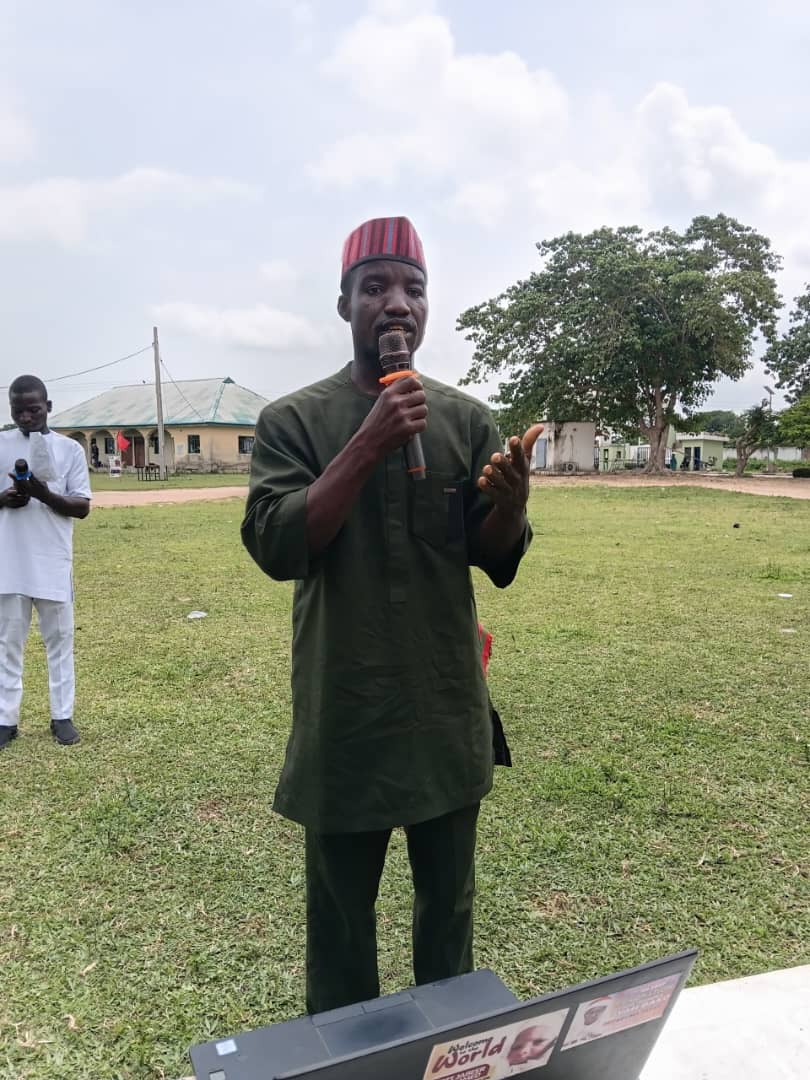
BEING A SPEECH DELIVERED BY USMAN DALHATU ABUBAKAR, (FORMER NABS FCT CHAPTER PRESIDENT AND CHIEF PRESS SECRETARY TO THE BCDU NATIONAL PRESIDENT CHIEF DR. PETER TUKURA) ON “UNITY IN DIVERSITY: BUILDING A STRONGER BASSA COMMUNITY” AT NABS NIGER STATE COLLEG
PROTOCOLS:
It is with profound gratitude to God Almighty, the Creator, Sustainer and protector of our life who has kept us safe and sound, healthy and hearty to be here today. I sincerely appreciate the leadership of the National Association of Bassa Students (NABS), Niger State College of Education, Minna, for finding me worthy of this invitation. It is indeed a privilege to share my thoughts on a topic that is not only timely but also essential for the survival and progress of our people, I do not take this kind gesture for granted.
The Chairman of Occasion and Chairman Board of Trustees NABS FCT Chapter, Mallam Haruna Ibrahim Gaiwa and his entourage, the father of the day Dr. Umar. Lisam of Federal University of Technology, Minna, the Patron and Chief Hon. Dr. Shawulu Mazadu, the former supervisory Councillor for Education and Social Development Kwali Area Council Hon. Alhassan Isah, the NABS President COE Minna, Comr. Attahiru Yusuf and his executives, distinguished guests, traditional leaders, fellow students, ladies and gentlemen, I am deeply honoured to stand before you today as your Guest Speaker during this year's Cultural Day celebration.

INTRODUCTION
While our theme, "Unity in Diversity: Building a Stronger Bassa Community, (literally meaning -Unu-tutwa nu Ụhwaŋna swoswoswo: Tụma Tụ na tԑ zhԑ ta 'ta udenji Bubassa kԑnyi) reminds us that although we may come from different regions, dialects, religions, educational backgrounds, and professions, we remain one people with a common heritage and destiny. However, it equally raises an important question: How can the Bassa people transform their diversity into a source of collective strength and development? This question is important in contemporary society, where globalization and social media is changing lifestyles and political competition are transforming traditional communities.
UNDERSTANDING UNITY, DIVERSITY AND UNITY IN DIVERSITY:
WHAT IIS UNITY: The term Unity refers to state of being together in harmony, working towards common values or goals irrespective of differences in background or opinion. Unity doesnt necessitate a flattening or an indivisibility but simply having the same aim in mind. True unity involves mutual respect, tolerance, cooperation; trust; shared responsibility; peaceful conflict resolution; collective action; recognition of common interests; and willingness to sacrifice personal interests for the wider community.
DIVERSITY: Diversity refers to the many different characteristics in which group of people possess that makes them unique. These differences may be social, cultural, geographical, religious, economic, political, linguistic, generational or professional. Within a community, if properly harnessed, diversity can produce different ideas, talents, experiences and perspectives that can stimulate creativity and innovation.
Therefore, UNITY IN DIVERSITY according to Wikipedia, is a concept of achieving harmony and peace among people who have different cultural, language, and beliefs”. It simply means maintaining our togetherness despite our differences. It is not just about tolerance, but acceptance. Since no society is completely homogeneous, then we should accept and embrace as such. Therefore, these differences should not divide us; rather, they should strengthen us.
As Bassa people we are known to have spread across the north central states of Nigeria and several and other parts of the country. Likewise, our customs and dialects differ slightly from one location to another, though our cultural identity remains one.

DIVERSITY IN BASSA COMMUNITY:
A typical Bassa community can contain differences based on following:
1. Geographical location: A typical Bassa community is made up of people from different states, local government areas, towns and villages. These differences in geographical locations attributed to slight variations in our customs, accents, traditional rites, dances, musical instrument and other practices.
2. Family and clan affiliations: Naturally, most Bassa communities may be dominated by one clan, but other clans also exist in the same community. For instance, in an Omono-based community, members of Ekubiri, Alumaluma, Akwakwa, Ekemtunwi (Akilono) may also be found. Despite these differences, strong family and ancestral connections are continued to exist among them.
3. Religion: Also in a typical Bassa community, members of the same family may belong to different religious traditions. For example, some families, such Tawari family of Kogi State, Agaba and Gaiwa families in FCT and Wodi family in Nasarawa State, both have Muslims and Christian living under the same roof.
4. Generation: Toady many young people have different perspectives and worldviews that differ from those of older generations. These differences are influenced by changes in our social environment as well as in increased exposure physical and social media.
5. Education: From traditional education to religious knowledge and to Western, education, members of the same family possess different levels and fields of education.
6. Occupation: Unlike our forefathers who mainly engaged in farming, fishing, carving, hunting, Western education has significantly reshaped our occupations today. Business, civil service, politics, entrepreneurship and other professional careers have taken the lead.
7. Political orientation: Like every other society in the modern world, our communities are politically diverse. Members of the same family or community may support or belong to different political parties and may choose to support different political candidates. Despite these political differences, however, our shared identity and sense of community remain important.
8. Language and cultural practices: While our collective identity remains the same, our dialects, cultural practices and patterns of interaction vary geographically. From Bassa to Tawari, Nuku to Gomani, Gwagwalada to Gui, Kagara to Kapako, Toto to Kpakwu-Bassa to mention but a few, our people shared common identity. However, our customs, dialects, festivals and other cultural practices may slightly vary from one region to another.

WHY UNITY MATTERS IN THE BASSA COMMUNITY
Unity is the foundation of a strong and progressive Bassa community. Although we may differ in our political views, religious beliefs, locations and personal interests, our shared identity and common aspirations should always bring us together. Through unity, we can attract meaningful development and empower our youths economically and socially, promote education, protect our collective interests, encourage responsible leadership and as well as preserving our language and cultural heritage. Unity does not mean that we must think alike; rather, it means that our differences should never prevent us from pursuing common goals. If we learn to respect one another, put the interest of the community above personal differences and work together with one voice, the Bassa community will become stronger, more organized and better positioned to contribute meaningfully to the development of our society and the nation at large. Our diversity is our identity, but our unity is our strength.
AMID DIVERSITY, THE ROLE OF STUDENTS IN BUILDING A Strong IN BASSA COMMUNITY
As students, we must realise that we occupy a unique position in shaping the future of the Bassa nation. Intellectually, student represent the future of our society. As well, they are the future leaders, future custodians of history and cultural heritage -people whom society will look up to in the years ahead. For instance, in 1963 a group of young and promising people from different geographical background, religious beliefs and political ideologies who were intellectually driven and visionary but guided by shared cultural values, took a deliberate step that gave birth to what is now known as NABS -the National Association of Bassa Students. The National Association of Bassa Students was established not merely for social gatherings but as an organization dedicated to producing future leaders who are intellectually sound, morally upright, and culturally conscious.
Distinguished guests and fellow students, you will agree with me that NABS, which is a product of unity in diversity, has served as a leadership and academic platform for many prominent personalities we know in our society today.
For example, HRH Dr. David Wodi Tukura, Aguma Turuku (Rtd.) of Chiefdom, Barr. Yusuf Huleji Wodi (Rtd.), former Solicitor General of the FCT Administration, Dr. Adamu Shuaibu (Rtd.), former Director-General of CSDP, and Chief Dr. Peter Tukura, National President of the Bassa Cultural and Development Union, Nigeria, all served NABS diligently at different points in their lives.
These individuals come from different geographical locations, religious backgrounds, and clans, yet they were united by a shared identity and a common purpose. Their contributions to NABS have continued to yield positive results, as the association has played, and continues to play, a significant role in shaping and advancing the Bassa community in all walks of life.
As Nelson Mandela once said, "Education is the most powerful weapon which you can use to change the world." Therefore, as students who are learned, we can promote unity amid diversity by:
i. Respecting one another regardless of religious or political differences.
ii. Participating actively in cultural programmes.
iii. Learning and speaking the Bassa language.
iv. Mentoring younger students.
Promoting peace within and outside our campuses.
v. Using social media responsibly to unite rather than divide our people.
OVERCOMING CHALLENGES TO UNITY:
Unfortunately, many of our community experience setbacks because of unnecessary divisions arising from socio-cultural politics, religion, personal interests, and geographical differences. These challenges can be overcome through dialogue, mutual respect, transparency, forgiveness, and inclusive leadership. As Bassa people, we must refuse every form of division that weakens our collective strength. Some of the major obstacles confronting unity among our people include:
i. Tribal and clan rivalry.
ii. Religious intolerance.
iii. Political differences.
iv. Leadership conflicts.
v. Lack of communication.
vii. Youth disengagement.
viii. Declining interest in cultural activities.
BUILDING A STRONGER BASSA COMMUNITY
A stronger Bassa community requires deliberate effort. We must invest in:
(1). EDUCATION: Educated youths become community assets capable of providing innovative solutions to societal problems.
(2). ECONOMIC EMPOWERMENT: Successful entrepreneurs should mentor young people and create employment opportunities.
(3). LEADERSHIP DEVELOPMENT: Young people should prepare themselves for responsible leadership with integrity, discipline, and service as you we must participate in both partisan and non-partisan politics.
(4). COMMUNITY SERVICE: Every educated Bassa son and daughter should give back to the community through mentorship, scholarships, health campaigns, and humanitarian services. Volunteerism should become part of our culture.

A CALL TO ACTION:
Fellow Bassa students, the future of the Bassa nation lies in our hands. We all have common enemy and our enemy does not recognize who is a Christian or Muslim, who is from Omono. Ekubiri, Alumaluma, Akwakwa or Ekemtunwi clan, who is from FCT, Niger, Kogi, Nasarawa, Kwara or Benue.
Therefore, we shouldn’t allow division to define our generation.
Let our friendships cross religious and political boundaries.
Let celebrate one another.
Let support one another.
Let encourage excellence.
Let protect our cultural identity.
Let be ambassadors of peace wherever we find ourselves.
CONCLUSION:
As I conclude, permit me to remind us that unity is not built by words alone; it is built through daily actions, mutual respect, shared responsibility, and collective sacrifice. Our diversity should never become a reason for division. Instead, it should become the foundation upon which we build a stronger, more united, and more prosperous Bassa community. If every one of us commits to promoting peace, preserving our culture, supporting education, and serving humanity, then the future of the Bassa people will undoubtedly be brighter than our past. Let today's Cultural Day be remembered as the beginning of renewed commitment toward unity and community development. I leave you with the words of Helen Keller: "Alone we can do so little; together we can do so much."
May God bless the National Association of Bassa Students.
May God bless the Bassa Nation.
May God bless the Federal Republic of Nigeria.

Oku ma
REFERENCES
Abiodun Akinola Oladiti & Elizabeth I. Wahab (2013). Promoting Unity in Diversity in Nigeria Through Social Studies Implications for National Unity Nigerian Journal of Social Studies, Vol. XVI (2)
Achoba, F. (2019). Ibara (Bassa-Nge), her neighbours and intergroup relations, 18401900. Federal University Lokoja.
Alex Gwatana Sokwo (2024). Cultural Heritage, Understanding and Appreciating Bassa Culture and its Relevance in Todays Society. National Association of Bassa Student 2024 Covention.
Atiku Abubakar (2021). Unity In Diversity. Being A Speech Delivered at Arewa House on Thursday 4th November 2021. Retrieved from atiku.medium.com/unity-in-diversity-186f297f5c29
Dangana, N. S. & Denwi, J. A.
(2026, August 15). Personal translation of “Unity in Diversity: Building a Stronger Bassa Community” into [Unu tutwa na ahaŋsa fugwo: Tumaa tu na ti zhɛ to gomicingo Bubassa
Denwi, J. A. (2024). National Association of Bassa Students (NABS); A Platform for Academic, Social Life and Cultural Exchange
Emmanuel Ukpe (2025). Diversity toward Unity and Sustainable Growth in Nigeria: Fostering Inclusivity for a Prosperous Future. Asian Business Research Journal Vol. 10, No. 4, 1-6, 2025 ISSN: 2576-6759 DOI: 10.55220/25766759.331
Mandela, N. (2003). Lighting Your Way to a Better Future. Johannesburg: Nelson Mandela Foundation.
Nyizo S. D (2026)
UNESCO. (2019). World Atlas of Languages. Paris: UNESCO.
UNESCO. (2022). International Decade of Indigenous Languages (20222032). Paris: UNESCO.
United Nations. (2015). Transforming Our World: The 2030 Agenda for Sustainable Development.
- Usman Dalhatu Abubakar
💬 Discussions (0)
No comments yet. Be the first to comment!