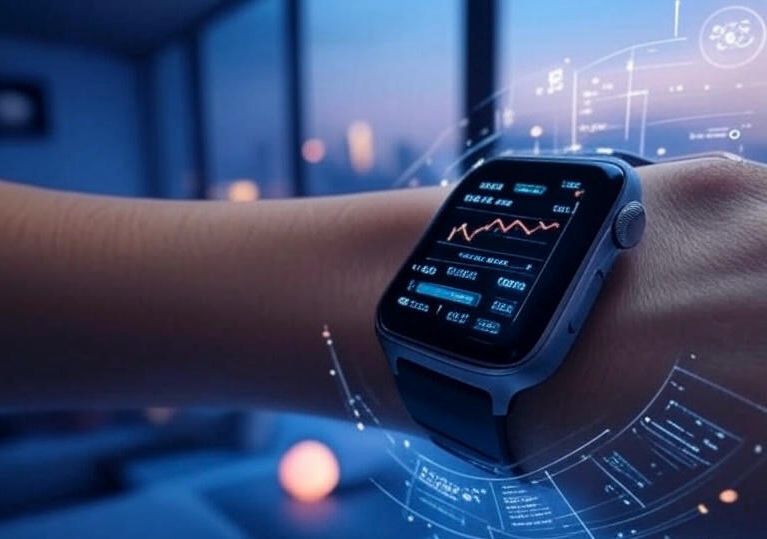
The Future on Your Wrist: How AI-Powered Wearables Are Redefining Personal Tech
In 2025, wearable technology is no longer just about counting steps or tracking heart rates. The integration of artificial intelligence (AI) into devices like smartwatches, fitness bands, and even smart rings has transformed these gadgets into intuitive companions that anticipate your needs, enhance your health, and seamlessly connect you to the digital world. From personalized health insights to real-time productivity boosts, AI-powered wearables are redefining what personal technology can do.
The AI Revolution in Wearables
Wearable tech has come a long way since the early days of clunky fitness trackers. Today’s devices, powered by advanced AI algorithms, are smarter, smaller, and more capable than ever. Companies like Apple, Samsung, and emerging players like Oura and Whoop are embedding AI directly into their devices, leveraging machine learning to process massive amounts of data in real time. These wearables don’t just collect data—they interpret it, learn from it, and act on it.
For example, modern smartwatches use AI to analyze biometric data like heart rate variability, sleep patterns, and even blood oxygen levels to provide actionable health insights. Instead of simply reporting that your heart rate spiked, an AI-powered device might detect early signs of stress or fatigue and suggest a quick breathing exercise or a break. Some devices, like the latest Apple Watch, can even predict potential health issues, such as atrial fibrillation, and prompt users to seek medical advice before symptoms escalate.
Beyond Fitness: AI as Your Personal Assistant
AI wearables are moving beyond health and fitness to become all-purpose digital assistants. With natural language processing (NLP) capabilities, devices like the Samsung Galaxy Watch 8 or the Fitbit Versa 5 can understand voice commands with unprecedented accuracy, even in noisy environments. These wearables integrate with AI models like Grok (created by xAI) to answer questions, set reminders, or control smart home devices—all from your wrist.
Imagine this: You’re running late for a meeting, and your smartwatch detects your elevated heart rate and calendar conflict. It automatically sends a polite message to your team, reschedules your next appointment, and suggests a quicker route to your destination based on real-time traffic data. This level of proactive assistance, powered by AI, is becoming standard in 2025’s wearable tech.
Privacy and Power: The Challenges Ahead
As exciting as AI-powered wearables are, they come with challenges. Privacy is a major concern, as these devices collect highly personal data, from sleep habits to medical metrics. Companies are responding with on-device AI processing, which keeps sensitive data local rather than sending it to the cloud. Apple, for instance, has doubled down on its “Privacy by Design” approach, ensuring that health data is encrypted and processed directly on the device.
Battery life is another hurdle. AI algorithms are computationally intensive, and wearables need to balance power efficiency with performance. Innovations like low-power AI chips and energy harvesting (using body heat or motion to charge devices) are helping, but we’re not quite at the point of week-long battery life for AI-heavy wearables.
The Future of Wearables
Looking ahead, the potential for AI-powered wearables is staggering. Researchers are exploring brain-computer interfaces that could allow wearables to detect and respond to neural signals, opening up possibilities for mental health monitoring or even thought-controlled interfaces. Meanwhile, augmented reality (AR) wearables, like smart glasses powered by AI, are gaining traction, promising to overlay digital information onto the physical world seamlessly.
In 2025, AI-powered wearables are more than gadgets—they’re partners in our daily lives. Whether it’s catching a health issue before it becomes serious, streamlining your workday, or simply helping you sleep better, these devices are proving that the future of tech isn’t just in your pocket—it’s on your wrist, in your glasses, or even on your finger. As AI continues to evolve, expect wearables to become even smarter, more intuitive, and indispensable.
Likes (
1 )
comments (
0 )
2025-08-10 19:44:32